 Image 1 of 2
 Image 2 of 2
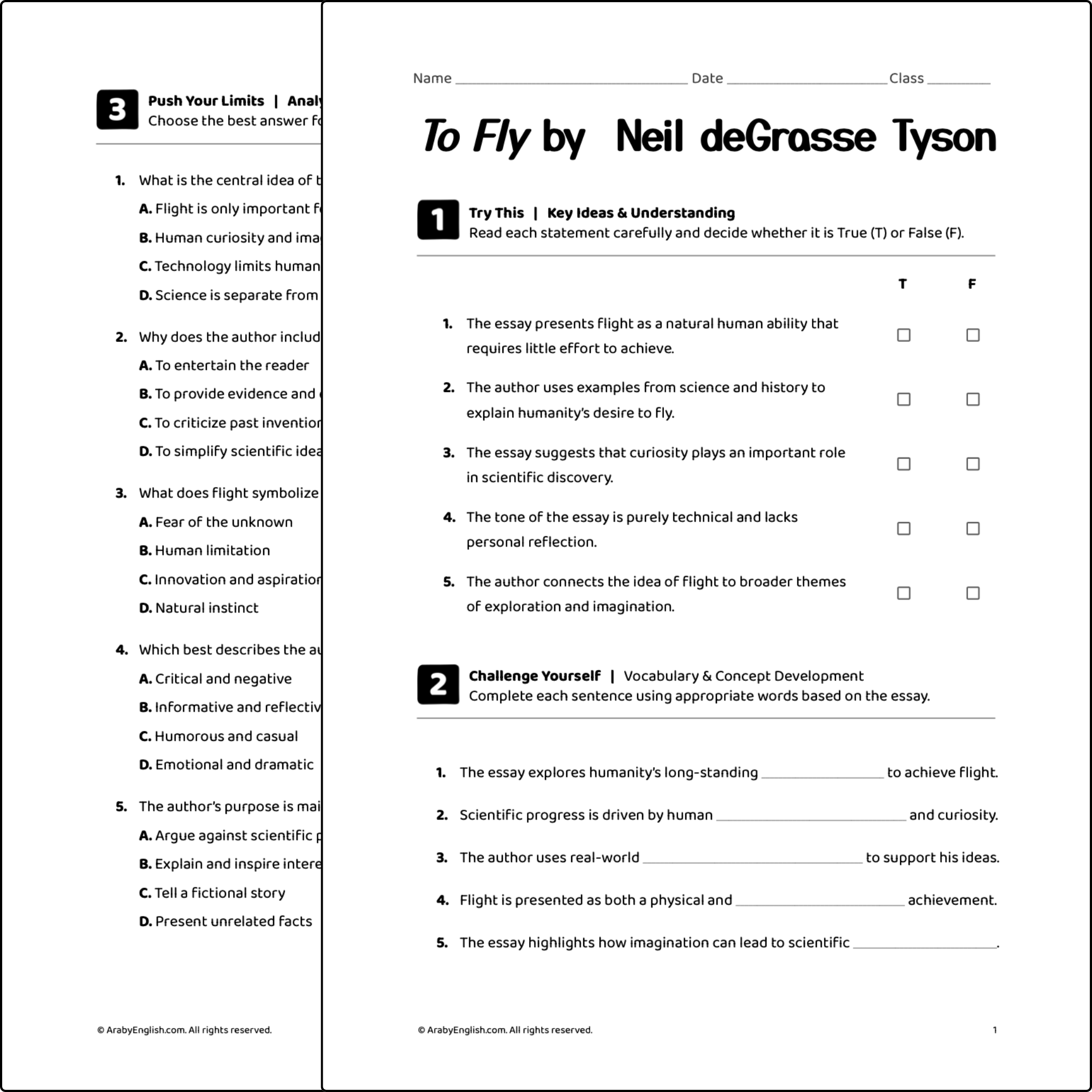
This Grade 12 worksheet explores “To Fly” by Neil deGrasse Tyson, focusing on the relationship between curiosity, imagination, and scientific progress. Through a variety of structured activities—true/false, fill-in-the-blanks, multiple choice, and open-ended responses; students develop advanced skills in analyzing informational texts, evaluating evidence, and making inferences. The worksheet aligns with CCSS, CEFR, ACARA, and Cambridge standards and is designed for high-level comprehension and critical thinking.
“Curiosity is the engine of scientific discovery, and imagination gives it wings.”
Focus Skill
1. Analyzing informational essays and scientific ideas.
2. Interpreting author’s purpose and tone.
3. Evaluating how examples support central ideas.
4. Making inferences about human curiosity and innovation.
Standards Alignment
✦ CCSS
RI.11-12.1: Cite strong and thorough textual evidence to support analysis of informational texts.
RI.11-12.2: Determine central ideas and analyze their development throughout the text.
RI.11-12.4: Analyze the meaning of words and phrases and their impact on meaning and tone.
RI.11-12.6: Analyze the author’s purpose, point of view, and rhetorical choices.
✦ CEFR
C1–C2: Demonstrate advanced comprehension, critical thinking, and evaluation of complex informational texts.
✦ ACARA
ACELY1742: Analyze how language features, text structures, and ideas shape meaning.
ACELT1812: Analyze and evaluate how texts represent ideas, experiences, and perspectives.
✦ Cambridge
Advanced (C1/C2) Reading & Use of English: Analyze complex texts, evaluate evidence, and interpret authorial choices.