 Image 1 of 1
“They tell us that the only thing we have to fear is fear itself; but I don’t believe that. Fear is there, all right... It takes on many shapes, assumes different forms, and so comes to overwhelm us.”
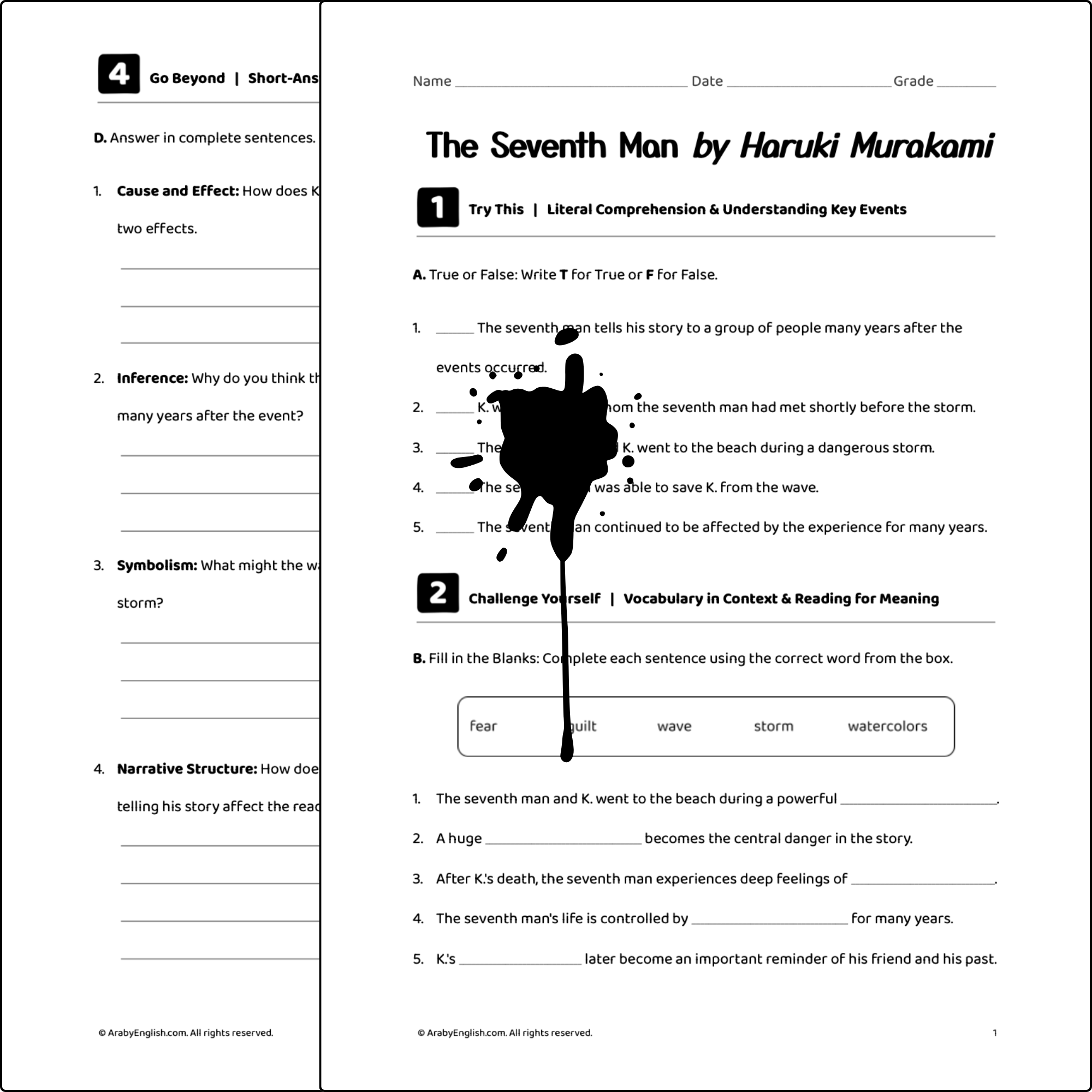
This comprehensive reading comprehension worksheet guides students through Haruki Murakami’s short story, "The Seventh Man". It features five scaffolded sections designed to build literary analysis skills:
Section 1 (Try This): True/False questions testing recall of key plot events and character relationships.
Section 2 (Challenge Yourself): Fill-in-the-blank vocabulary exercise contextualizing core thematic words (e.g., guilt, fear, watercolors).
Section 3 (Push Your Limits): Multiple-choice questions assessing narrative structure, symbolism, and inference.
Section 4 (Go Beyond): Short-answer analytical questions focusing on cause-and-effect relationships, theme, and the frame story technique.
Section 5 (Extension Task): An open-ended paragraph response requiring students to construct a evidence-based claim on fear and guilt.
Skill Explanation
Literary analysis means looking beyond what happens in a story to examine how and why the author presents events, characters, ideas, and literary techniques. In this worksheet, students analyze the narrator's experience, draw inferences, examine the story's frame structure, interpret symbolism, and support their ideas with evidence from the text.
Standards Alignment
✦ CCSS
RL.9–10.1: Cite strong and thorough textual evidence to support analysis of what the text says explicitly and inferences drawn from the text.
RL.9–10.2: Determine a theme or central idea and analyze its development.
RL.9–10.5: Analyze how an author's choices concerning structure and the order of events create effects such as mystery, tension, or surprise.
RL.9–10.6: Analyze a particular point of view or cultural experience reflected in a work of literature.
W.9–10.4: Produce clear and coherent writing appropriate to the task and purpose.
✦ CEFR: B1–B2
Reading: Understand the main ideas and significant details of literary texts.
Reading: Draw conclusions and infer meaning from context.
Writing: Give reasons and explanations for opinions and interpretations.
Writing: Organize ideas into a clear, connected response.
✦ ACARA
Language: Understand how language choices create meaning and effect.
Literature: Analyze how texts represent experiences, ideas, and perspectives.
Literacy: Analyze and evaluate how authors use language and structural choices to influence readers.
✦ Cambridge English
Reading: Identify explicit information and implied meaning.
Reading: Analyze the writer's purpose, attitude, and use of language.
Writing: Develop and communicate ideas clearly with appropriate supporting details.