 Image 1 of 1
Difficulty: Medium to Difficult
Grade 6-7
5 pages total
Includes brief explanation
4 differentiated practice exercises
1-page answer key included
“Facts give us knowledge, but opinions shape how we interpret the world.”
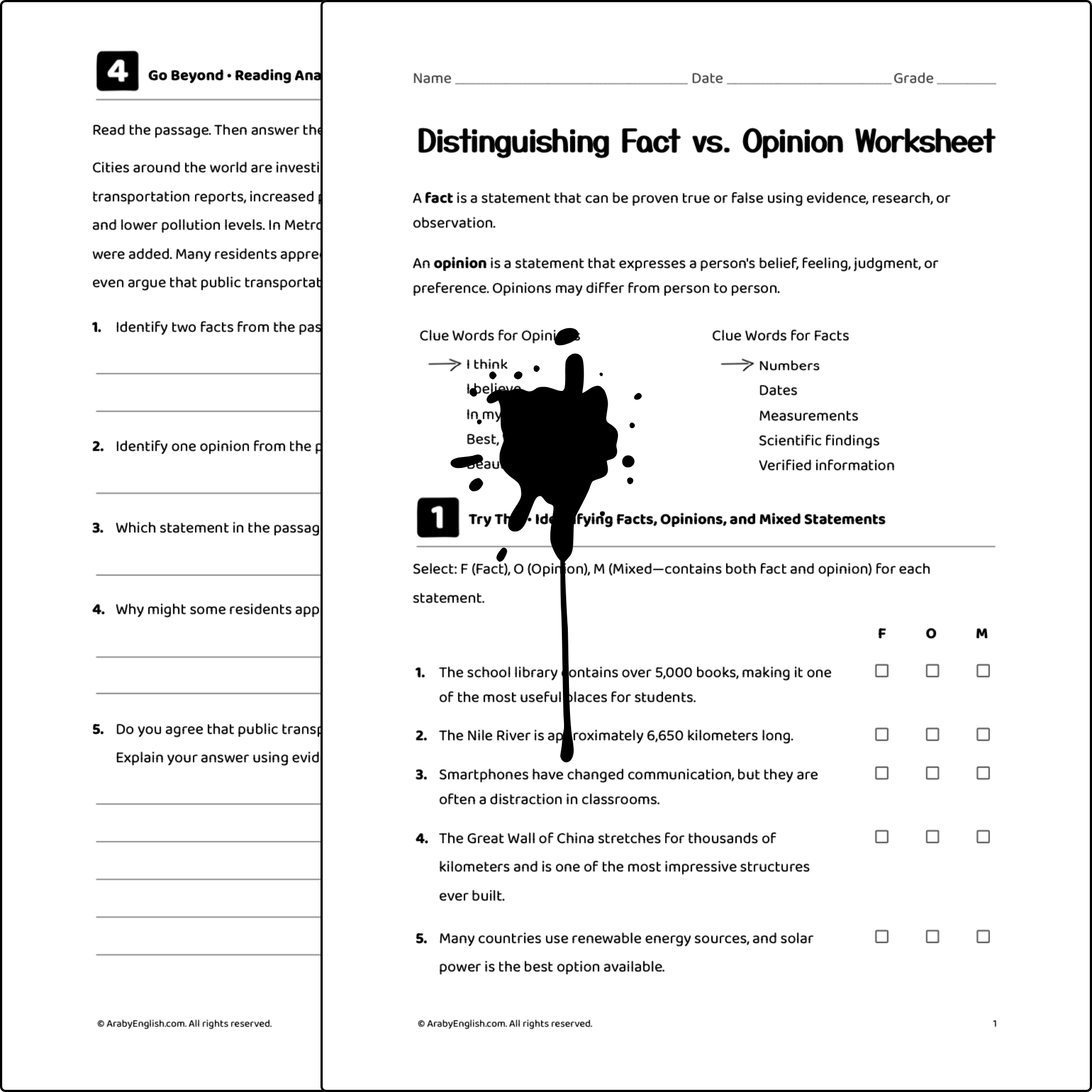
This worksheet helps students distinguish between fact, opinion, and mixed statements through progressively challenging tasks. It includes true/false classification, evidence-based identification, multiple-choice reasoning, and a higher-order reading comprehension passage with inference and evaluation questions. Students also analyze author viewpoint, identify bias, and justify answers using textual evidence. Designed for upper primary and lower secondary learners, it builds critical reading and analytical thinking skills aligned with international standards.
Standards alignment
CCSS
- RI.6.8: Trace and evaluate the argument and specific claims in a text, distinguishing claims that are supported by reasons and evidence from claims that are not.
- RI.7.8: Trace and evaluate the argument and specific claims in a text, assessing whether the reasoning is sound and the evidence is relevant and sufficient.
- RI.6.1: Cite textual evidence to support analysis of what the text says explicitly as well as inferences drawn from the text.
- RI.7.1: Cite several pieces of textual evidence to support analysis of what the text says explicitly and inferentially.
- W.6.1 / W.7.1: Write arguments to support claims with clear reasons and relevant evidence.
CEFR (B1+/B2)
- Can distinguish between factual information and personal opinions in straightforward texts.
- Can identify supporting reasons and evidence for a viewpoint.
- Can recognize the writer's attitude or perspective in familiar topics.
- Can evaluate arguments and distinguish between objective and subjective information.
- Can identify bias, assumptions, and persuasive language in texts.
- Can draw conclusions and justify opinions using evidence from reading passages.
ACARA
- AC9E6LA02: Understand how language choices influence meaning and audience response.
- AC9E7LA01: Explain how texts reflect viewpoints and values.
- AC9E6LY03: Analyze how text structures and language features distinguish facts, opinions, and perspectives.
- AC9E7LY05: Evaluate information and ideas, distinguishing between evidence-based claims and personal viewpoints.
- Analyze information from different sources.
- Evaluate evidence and reasoning used to support claims.
Cambridge
- Identify facts, opinions, attitudes, and viewpoints in a range of texts.
- Distinguish between objective information and subjective judgments.
- Recognize persuasive and evaluative language.
- Analyze arguments and supporting evidence.
- Evaluate the reliability of information.
- Draw reasoned conclusions from textual evidence.
- Support opinions with relevant evidence and examples.
- Present balanced arguments and viewpoints.