BLOG POST 5
If you’re an educator, language school administrator, or a learner navigating the world of education, you’ve likely come across two common terms: diagnostic test and placement test. Although they might sound similar, they serve different purposes in the learning journey. Understanding their differences can help ensure students get the support they need from the very beginning.
Diagnostic Test vs. Placement Test
✔
Diagnostic Test vs. Placement Test ✔
1. What Is a Placement Test?
A placement test is designed to determine a learner’s current level of proficiency in a subject—most commonly in language programs. It helps place students in the class or level that best matches their skills.
Purpose:To group students by ability level so that they start learning at the right point.
When is it used? Before the start of a course or program.
Example: A new English language student takes a placement test that assesses grammar, vocabulary, reading, and writing. Based on the results, they are placed in a “Beginner” or “Intermediate” class.
2. What Is a Diagnostic Test?
A diagnostic test digs deeper. It’s used to identify a student’s specific strengths and weaknesses in certain areas. The goal is to inform instruction and guide personalized learning strategies.
Purpose:To uncover learning gaps and areas needing reinforcement.
When is it used? At the beginning of a course, after placement, or even mid-course, to tailor instruction.
Example: A student placed in a Pre-Intermediate class takes a diagnostic test that reveals they struggle with past tense verbs but are strong in vocabulary. The teacher can then focus grammar lessons to target this gap.
3. Key Differences at a Glance
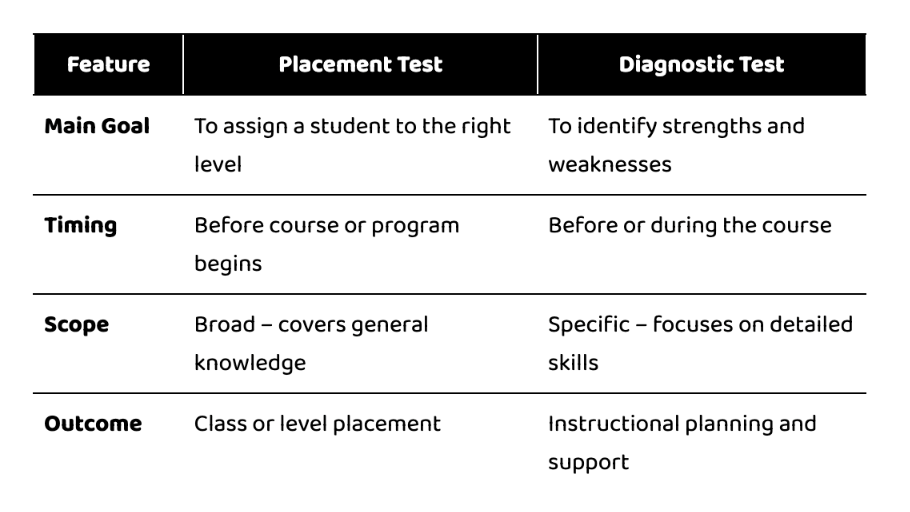
4. Why Both Are Important
While a placement test gets students into the right class, a diagnostic test fine-tunes instruction to help them succeed within that class. Used together, they offer a powerful way to personalize learning from day one.
Final Thoughts
Whether you're running a language school or preparing your own teaching plan, using both placement and diagnostic testing ensures no student is left behind or held back. They're like two tools in a teacher’s toolbox, one to find the starting line, and one to guide the path forward.